


The numbers tell a quiet story. In the last year, 43% of Americans renovated their home. Another 33% plan to do so in the coming year. But the most striking figure isn't about the renovations themselves it's about what homeowners chose not to do. Roughly two-thirds of recent renovators decided to upgrade their current home instead of moving to a new one. For those planning to renovate in the next year, that number climbs to 71%.
That data, from a Redfin-commissioned survey of 4,000 U.S. residents conducted by Ipsos in November 2025, reflects something deeper than a housing market quirk. It captures a fundamental shift in how homeowners think about their living spaces: not as assets to be optimized for the next buyer, but as homes to be shaped around their own evolving needs.
"The typical age of a home has increased from 31 years old in 2006 to 41 years old in 2023," said NAHB Economist Eric Lynch at a panel during the International Builders' Show in Orlando. "And with the dramatic rise in home equity post-pandemic, more homeowners are able to finance remodeling projects that align with their needs."
This is the story of the stay-at-home renovation and what it means for how Americans are choosing to live.
Why Homeowners Are Staying Put
The housing market has always had its rhythms. Buy, improve, sell, repeat. For decades, the conventional wisdom held that every renovation should be evaluated through the lens of resale value. Kitchens and bathrooms, the thinking went, delivered the best return on investment. A fresh coat of paint before listing was practically mandatory.
That calculus is changing. The Redfin data shows that homeowners are staying put because it is expensive to move a combination of transaction costs, mortgage rate lock-in, and a broader recognition that their current home, with the right upgrades, can serve them well into the future. The mortgage rate lock-in effect, where homeowners with low rates choose to remain in place rather than take on higher borrowing costs, continues to shape behavior even as it lessens over time.
"While the lock-in effect is lessening, it is still persisting, which means households will be incentivized to pursue remodeling projects first before considering a sale," Lynch explained.
Meanwhile, rising home equity has given homeowners the financial runway to fund those projects. According to Forbes' reporting on home equity trends, this wealth accumulation has unlocked a wave of investment in existing properties not to flip them, but to live in them more fully.
The $425 Billion Remodeling Boom
The scale of this shift is staggering. Americans spent an estimated $603 billion on home remodeling projects in 2024, according to the 2025 Remodeling Impact Report from the National Association of Realtors and the National Association of the Remodeling Industry. By 2027, projections suggest the market could reach $425 billion annually driven in no small part by the aging housing stock.
"By 2025, nearly 90% of U.S. homes will be over 20 years old," noted Redfin's analysis of the remodeling boom. "That's a lot of houses starting to show their age from outdated kitchens and bathrooms to drafty windows and worn-out doors."
For homeowners, this isn't just a maintenance challenge. It's an opportunity to reimagine their living spaces for how they actually want to spend the next decade or two not how a hypothetical future buyer might value them.
When Joy Outweighs ROI
The 2025 Remodeling Impact Report introduced a revealing metric: the Joy Score. Homeowners rate their renovation happiness on a scale of 1 to 10 upon completion. The results challenge the traditional resale-value framework.
The projects with the highest Joy Scores a perfect 10 include the addition of a primary bedroom suite, a kitchen upgrade, and new roofing. These are not, traditionally speaking, the highest-return renovations. The projects with the best cost recovery tell a different story: a new steel front door recovers 100% of its cost, a closet renovation recovers 83%, and a new fiberglass front door recovers 80%.
"Homeowners undertake remodeling projects for numerous reasons, but what remains intriguing is the disparity between the joy experienced post-remodel and the actual cost recovery," said Jessica Lautz, NAR deputy chief economist and vice president of research. "While homeowners take pride in seeing their personal tastes and design choices come to life, Realtors may recommend different strategies to enhance the property's resale value."
This gap between personal satisfaction and resale optimization is the central tension of the new remodeling era. Homeowners are increasingly choosing the former.
The Aging-in-Place Transformation
Nowhere is this shift more evident than in the aging-in-place movement. The NAHB/Westlake Royal Remodeling Market Index a quarterly survey of NAHB remodeler members has registered a reading above the break-even point of 50 for 24 consecutive quarters, "showcasing a post-pandemic resiliency," according to NAHB's February 2026 outlook.
Within that broader growth, aging-in-place work stands out. The RMI survey showed that 56% of remodelers are involved in home modification work relating to aging in place. Even more telling: 96% of remodelers said that most or some of their consumers are familiar with the aging-in-place concept. And 73% of respondents indicated that requests for aging-in-place features have significantly or somewhat increased.
This isn't a niche trend. It's becoming a mainstream expectation. As the population ages and homeowners increasingly view their properties as lifetime residences, the demand for features that support long-term comfort and accessibility is reshaping renovation priorities room by room.
Room by Room: What Homeowners Are Prioritizing
The data from NARI's report offers a detailed look at where homeowners are directing their attention and how those priorities are evolving.
When consumers remodel their homes, the primary reasons include upgrading worn-out surfaces, finishes, and materials (27%); improving energy efficiency (19%); desiring a change (18%); and preparing to sell (a smaller share than in previous eras). The top projects where Realtors have observed the highest increase in demand are kitchen upgrades (48%), new roofing (43%), and bathroom renovation (35%).
These aren't just aesthetic choices. A kitchen upgrade often means wider doorways, lever-style faucets, and countertops at accessible heights. A bathroom renovation might include walk-in showers, grab bars, and non-slip flooring. The features that make a home more livable for aging residents often overlap with those that make a home more comfortable for everyone.
Essential Modifications for Aging in Place
While the locked sources don't provide a comprehensive list of specific aging-in-place modifications, the data points to several categories of investment that are gaining traction:
- Primary suite additions and expansions The highest Joy Score in the NARI report reflects a desire for private, accessible living space on a single floor.
- Bathroom accessibility upgrades Walk-in showers, grab bars, and curbless entries address mobility challenges while delivering high satisfaction.
- Kitchen accessibility features Lowered countertops, pull-out shelving, and easy-grip hardware support independent living.
- Entryway modifications Zero-threshold entries, wider doors, and ramp-ready designs accommodate mobility devices.
- Lighting and flooring improvements Better illumination and slip-resistant surfaces reduce accident risk throughout the home.
The Business of Staying Home
The remodeling sector is not just growing it's structurally changing. There were 128,000 remodeling firms at the start of 2025, up from 69,000 in 2000, according to NAHB data. Home improvement spending share increased from 33% in 2007 to 44% in the first quarter of 2025.
"The remodeling sector is continuing to become a larger share of the residential construction market, especially when looking at the number of firms and overall construction spending," Lynch noted.
This growth is creating new opportunities for remodelers who understand the aging-in-place market. The RMI data shows that more than half of remodelers are already doing this work, and the vast majority report increasing demand. For contractors and design professionals, the ability to speak to long-term livability not just resale appeal is becoming a competitive differentiator.
Comparing Joy and Return: What the Data Shows
The tension between personal satisfaction and financial return is one of the defining characteristics of the current remodeling landscape. The following comparison illustrates where these two measures align and where they diverge.
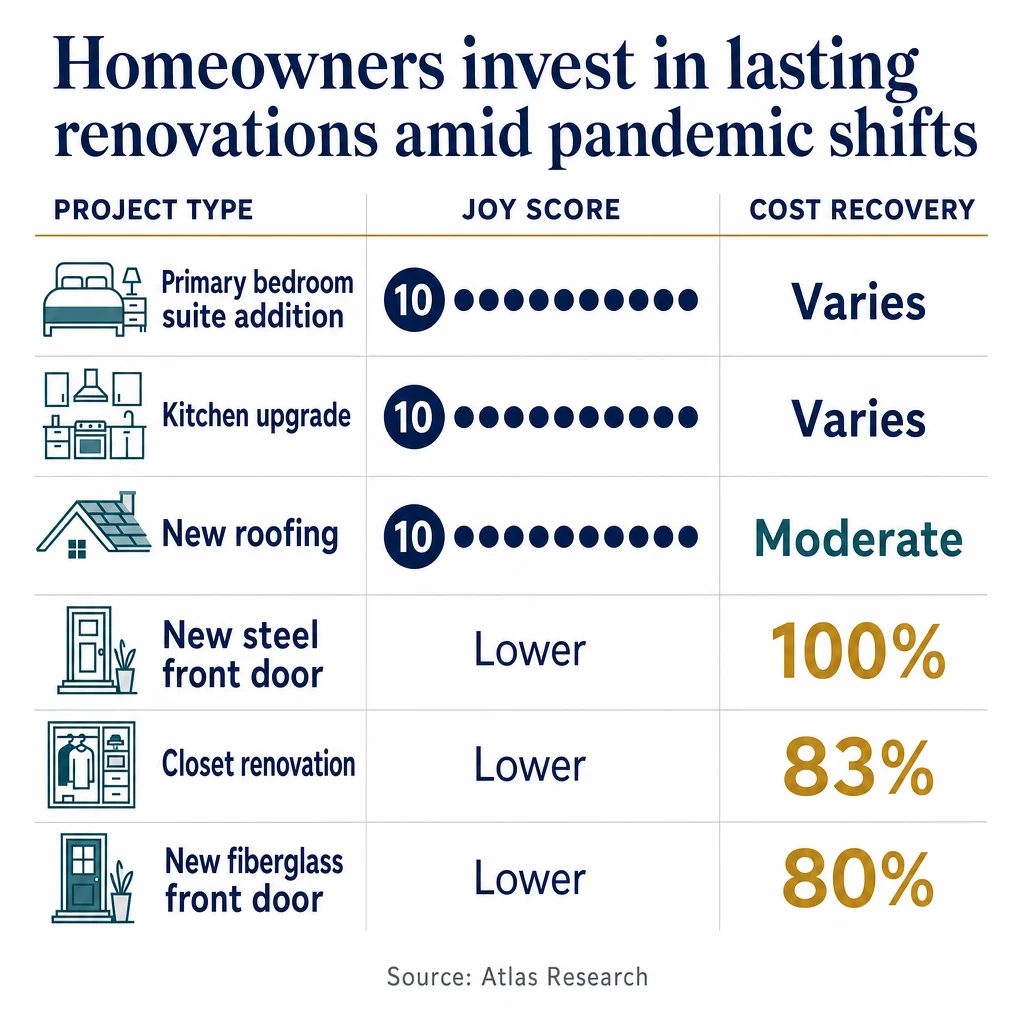
| Project Type | Joy Score (out of 10) | Cost Recovery (%) |
|---|---|---|
| Primary bedroom suite addition | 10 | Varies |
| Kitchen upgrade | 10 | Varies |
| New roofing | 10 | Moderate |
| New steel front door | Lower | 100% |
| Closet renovation | Lower | 83% |
| New fiberglass front door | Lower | 80% |
The pattern is clear: the projects that deliver the most personal joy often recover less of their cost at resale. Conversely, the projects with the highest financial return tend to score lower on homeowner satisfaction. For homeowners prioritizing long-term comfort over eventual sale, this comparison argues for investing in the features that matter to them not the ones that matter to the next buyer.
Why This Matters for NAHB, HIRI Readers
For professionals in the housing industry builders, remodelers, designers, and analysts the stay-at-home renovation trend carries significant implications. The traditional resale-first framework is giving way to a more personal calculus, where homeowners evaluate upgrades based on how well they serve current and future needs rather than how they will play on a listing.
This shift creates both opportunity and responsibility. Remodelers who understand aging-in-place principles are better positioned to serve a growing market. Builders developing new homes can incorporate universal design features that appeal to buyers at every life stage. Analysts tracking the housing market need to account for a consumer base that is increasingly oriented toward staying put and investing in their existing properties.
The data from NAHB, NARI, and Redfin converges on a single insight: the American relationship with home is changing. The decision to remodel is no longer primarily a financial one. It's a statement about how people want to live and how long they intend to stay.
What Homeowners Should Know
For homeowners considering their own renovation decisions, the research offers several practical takeaways.
First, the financial case for staying and remodeling is stronger than ever. With high transaction costs and mortgage rate lock-in, moving is expensive. A well-planned renovation can deliver better value than a new purchase.
Second, the gap between joy and ROI is real and it's okay to embrace it. If a primary suite addition or kitchen upgrade brings genuine satisfaction, the lower cost recovery at resale may be a worthwhile trade. Life is not a spreadsheet.
Third, aging-in-place features are increasingly mainstream. Features designed for long-term accessibility wider doorways, curbless showers, lever faucets add value not just for aging residents but for visitors, children, and anyone managing a temporary injury or mobility challenge.
Fourth, the market is responding. With 128,000 remodeling firms operating as of early 2025 and the sector continuing to grow, homeowners have more options than ever for finding professionals who understand long-term living design.
Where to Read Further
The data in this article draws from several key sources that offer deeper dives into the remodeling landscape:
- Redfin's April 2026 survey data on renovation trends and the stay-at-home decision
- NARI's 2025 Remodeling Impact Report with full Joy Score and cost recovery data
- NAHB's 2026 remodeling market outlook with RMI data and industry projections
- Redfin's analysis of the $425 billion remodeling boom and aging housing stock
- Forbes' reporting on home equity and remodeling technology
These sources provide the data behind the trend and the context for understanding what it means for the future of housing in America.