


On a typical Tuesday morning at an independent tire shop, the bays are full. Technicians are elbow-deep in wheel bearings and brake rotors. The lobby has three customers waiting for estimates. And the phone is ringing.
Someone reaches for it interrupting a tire mount mid-torque. The customer on the other end wants to know if you have 245/70R16s in stock. You don't know offhand. You put them on hold, walk to the parts room, scan the shelves, walk back, take them off hold. The answer is yes, but by now they've been waiting ninety seconds. Maybe they hung up. Maybe they're already calling the shop three miles away.
This scenario plays out dozens of times a week in tire shops across the country. And according to the operators who've studied it, the cumulative cost is substantial.
The Revenue Leak Nobody Talks About
"That's what most tire shop owners say too. Turns out, even missing 2-3 calls during busy periods is costing way more customers than they realized," according to TireShopAutoText's overview of missed call costs.
The math is stark. Research cited by automated phone service providers suggests that 30% of first-time callers hang up after three rings. Those aren't cold calls or wrong numbers they're potential customers with a vehicle that needs tires, brakes, or service. And they're calling your competition right now.
For a rural shop capturing just one or two additional customers daily, the impact compounds quickly. For an urban location during winter tire season, the difference can reach tens of thousands of dollars in additional revenue. One highway-adjacent shop began handling two to three emergency call-ins per weekend after implementing automated text-back calls that previously would have gone to voicemail and been forgotten.
The challenge isn't that tire shop owners don't care about missed calls. It's that during peak hours, answering the phone is physically difficult when your team is already engaged with vehicles in the bay. Voicemail feels impersonal and slow. Hiring a dedicated receptionist doesn't make financial sense for a shop doing thirty cars a week. And yet every unanswered ring represents real money walking out the door.
What Missed Call Text Back Actually Does
Missed call text-back is a straightforward concept: when a caller reaches an unanswered line, the system automatically sends them a text message. That message introduces your shop, acknowledges their call, and invites them to continue the conversation via text.
"Here's How It Works: 1. Customer calls your tire shop 2. They instantly get a professional text response 3. You see what they need and respond when convenient 4. No more interruptions. No more missed opportunities," according to TireShopAutoText's system description.
The key word is convenient. The system doesn't demand that someone answer immediately. It creates a written record of the customer's inquiry that the shop owner or manager can review between jobs, during a lunch break, or at the end of the day. By the time you respond, you already know what they need tire size, service type, preferred appointment window and you can respond with a specific answer rather than playing phone tag.
This approach addresses several friction points simultaneously. Customers get an immediate acknowledgment rather than voicemail silence. Shop staff can triage inquiries without dropping a wrench mid-job. And the conversation continues asynchronously, which many customers actually prefer for routine service questions.
The Difference From Traditional Phone Service
Traditional phone service creates a constant interruption loop. Customers get frustrated with voicemail. Shop owners miss calls during busy periods. Phone tag wastes everyone's time. The AI-powered alternative flips this dynamic.
"Customers get immediate response. You respond when convenient. See what they need before calling back. Professional communication every time," as TireShopAutoText contrasts the two approaches.
The text format also changes the information dynamic. A voicemail tells you someone called; a text inquiry tells you what they need. When a customer texts "Do you have Goodyear Wrangler 265/70R17 in stock?" you can answer that question directly. When they text "Need to schedule a tire rotation for my Silverado," you can check your schedule and offer a specific time slot all without a phone call.
AI Phone Answering: The Next Layer
Beyond simple text-back, more sophisticated AI phone answering systems can handle a broader range of customer interactions. These platforms use voice AI to answer calls, ask qualifying questions, and even book appointments directly into the shop's scheduling system.
"An AI system can handle these calls 24/7. It talks to customers, finds available slots in your schedule, and books them automatically. This means no more missed calls or customers having to wait on hold forever. It's like having an extra receptionist who never sleeps and never gets tired," according to AI Frontdesk's analysis of AI phone systems for tire shops.
These systems are trained on common tire shop inquiries: pricing for specific services, availability of tire sizes, appointment scheduling, and status updates on vehicles already in service. When a customer calls asking "How much for an oil change?" or "Can I bring my car in tomorrow morning?" the AI can handle the response without human intervention.
The operational benefit is significant. "Every minute a tech spends on the phone is a minute they're not turning wrenches. Every unanswered call is a bay that sits empty tomorrow," according to Dialzara's analysis of automotive shop efficiency.
What the Numbers Look Like
Providers of AI phone answering services for auto and tire shops cite meaningful operational improvements. One provider notes that shops using their system have booked 35% more appointments on average. Another reports that a shop previously sending 40% of calls to voicemail began booking 18 extra jobs per month after implementation.
"We were losing 15-20 calls a day when all three bays were full. Dialzara books our appointments now and our weekly car count is up by 30%," according to a testimonial from a shop owner cited by Dialzara's automotive service page.
The average repair order value protected by consistent phone coverage also factors into the calculation. One provider estimates $350 as the average repair order value that gets protected when calls are answered and appointments are booked rather than lost to voicemail.
Setting Up Automated Text Replies: The Practical Path
For tire shop owners considering this technology, the setup process has become increasingly streamlined. Most providers offer a straightforward onboarding that doesn't require technical expertise.
The basic steps involve connecting your existing business phone line to the automation platform, customizing message templates to reflect your shop's services and personality, and establishing response workflows for how incoming inquiries are routed and handled. Some platforms integrate directly with scheduling systems, allowing the AI to see available appointment slots and book customers without manual intervention.
"We Train Your AI. Your AI receptionist learns automotive terminology, your service menu, and scheduling rules," according to Dialzara's setup description. "Connect Your Shop Line. Forward your shop phone, overflow calls, or after-hours line in minutes."
The customization aspect matters. A good system should reflect your shop's specific services, labor rates, warranty policies, and scheduling constraints. The goal is a response that sounds like your shop professional, knowledgeable, and oriented toward getting the customer booked not a generic chatbot.
What to Look For in a Provider
Not all missed call automation systems are built for the specific realities of tire shops. Some are generic business automation tools that happen to work for automotive service. Others are purpose-built for the industry.
"Not some generic system this understands your business, your customers, and your daily challenges," according to TireShopAutoText's differentiation statement. "Personal Service from a Business Owner. You're working with Keith Langevin, who has 27 years of business experience and personally works with every tire shop."
Key features to evaluate include: the ability to handle common tire shop inquiries without routing everything to a human, scheduling integration that prevents double-booking, after-hours coverage for evening and weekend calls, and analytics that show call volume, peak hours, and common customer questions. Some systems also offer integration with over 9,000 applications via platforms like Zapier, allowing the phone automation to connect with your existing shop management software.
The Cost Question: What to Expect
Pricing for missed call automation and AI phone answering services varies by provider and feature set. Entry-level text-back systems typically involve a one-time setup fee plus a monthly service charge. More comprehensive AI answering platforms may charge per-minute usage or a flat monthly rate with included minutes.
One provider, TireShopAutoText, structures their pricing as: "Setup Fee: $500 (one time) Monthly Service: $297." Their marketing emphasizes that the service "pays for itself with just 1-2 additional customers per month."
For a shop doing 25-30 vehicles per week, capturing one or two additional booked appointments per month through previously missed calls is a realistic target. At an average ticket of $400-600 for tires and installation, the math works quickly. Many providers also offer money-back guarantees typically 30 days to reduce the risk of trying the system.
When evaluating cost, consider both the direct revenue impact and the indirect value: reduced interruption to shop floor productivity, better customer experience, and time reclaimed for owners and managers. "The money is great, but getting my life back is invaluable. I'm a better husband, father, and business owner because I'm not constantly stressed about missing calls," according to a testimonial from an Interstate Tire & Service owner cited by TireShopAutoText.
Beyond Booking: The Quieter Benefits
When tire shop owners talk about what surprised them after implementing missed call automation, the conversation often turns to quality of life. Not the revenue numbers those were expected but the reduction in daily stress.
"The phone was creating chaos in our shop. Someone would be in the middle of a tire mount, phone rings, they'd have to drop everything. It was stressing everyone out," according to a manager at Urban Wheel Works, as cited by TireShopAutoText.
That chaos has a real cost. Technicians who are interrupted mid-job make more mistakes. Owners who are constantly watching the phone can't focus on estimates, inventory, or staff development. And the customers who do get through often sense the frenzied energy on the other end of the line.
One owner in Montana reported taking his first real vacation in years after implementing the system. Another said he returned to being a better business owner and a better husband and father because he wasn't perpetually anxious about missing calls.
These aren't soft benefits. A shop where the team isn't constantly interrupted runs more smoothly. Estimates get written carefully. Vehicles get diagnosed thoroughly. Customers get better service because the people serving them can focus.
24/7 Coverage Without Adding Staff
For many independent tire shops, the phone coverage gap is widest in the evenings and on weekends exactly when customers are most likely to call. An AI phone answering system operates around the clock without requiring overtime pay or additional hiring.
"With our AI Voice Agents, your calls are answered every day of the week, ensuring that your customers get the assistance they need when they need it," according to In Motion Brands' description of their virtual phone answering service. "Whether a customer is calling during peak hours or after your business has closed, they can still get the information they need."
This matters for a specific reason: car trouble doesn't follow business hours. A customer whose tire goes flat at 7 PM is calling around to shops right then, not waiting until 8 AM. If your shop goes to voicemail, they call the next shop. If your AI answers, explains your evening hours, and books them for first thing tomorrow, you've captured that customer.
What This Means for FOMA Publishing Readers
For tire shop owners researching how to stop losing business from missed calls, the technology has matured to the point where implementation is straightforward and the return on investment is predictable. The core mechanism automatically turning unanswered rings into text conversations addresses the specific pain point directly, without requiring a dedicated receptionist or constant phone-watching.
The providers operating in this space range from purpose-built systems designed specifically for tire shops to broader AI answering platforms that can be customized for automotive service. The right choice depends on your shop's call volume, the complexity of inquiries you typically receive, and whether you want simple text-back or full AI voice answering with appointment booking.
Either way, the underlying principle is the same: every unanswered call is a potential customer who didn't have to be lost. The technology to capture those calls exists, it's affordable, and the setup process is no longer the barrier it once was.
Where to Read Further
For tire shop owners ready to explore missed call automation in more depth, the following resources provide additional context and provider options:
- TireShopAutoText Purpose-built missed call text-back system for tire shops, with pricing details and owner testimonials
- AI Frontdesk's guide to AI phone systems for tire shops Broader overview of AI answering capabilities and appointment automation
- Dialzara's automotive service page AI answering service with focus on appointment booking and shop efficiency metrics
- Auto Shop Receptionist AI-powered receptionist specifically trained for auto repair shop operations
- In Motion Brands' virtual phone answering service 24/7 AI call handling for tire and auto repair shops
For Marketing for Tire Shops and Phone Answering Software or Tire Shops, additional resources on implementation and provider selection are available through FOMA Publishing's partner directory.
Missed Call Automation: At a Glance
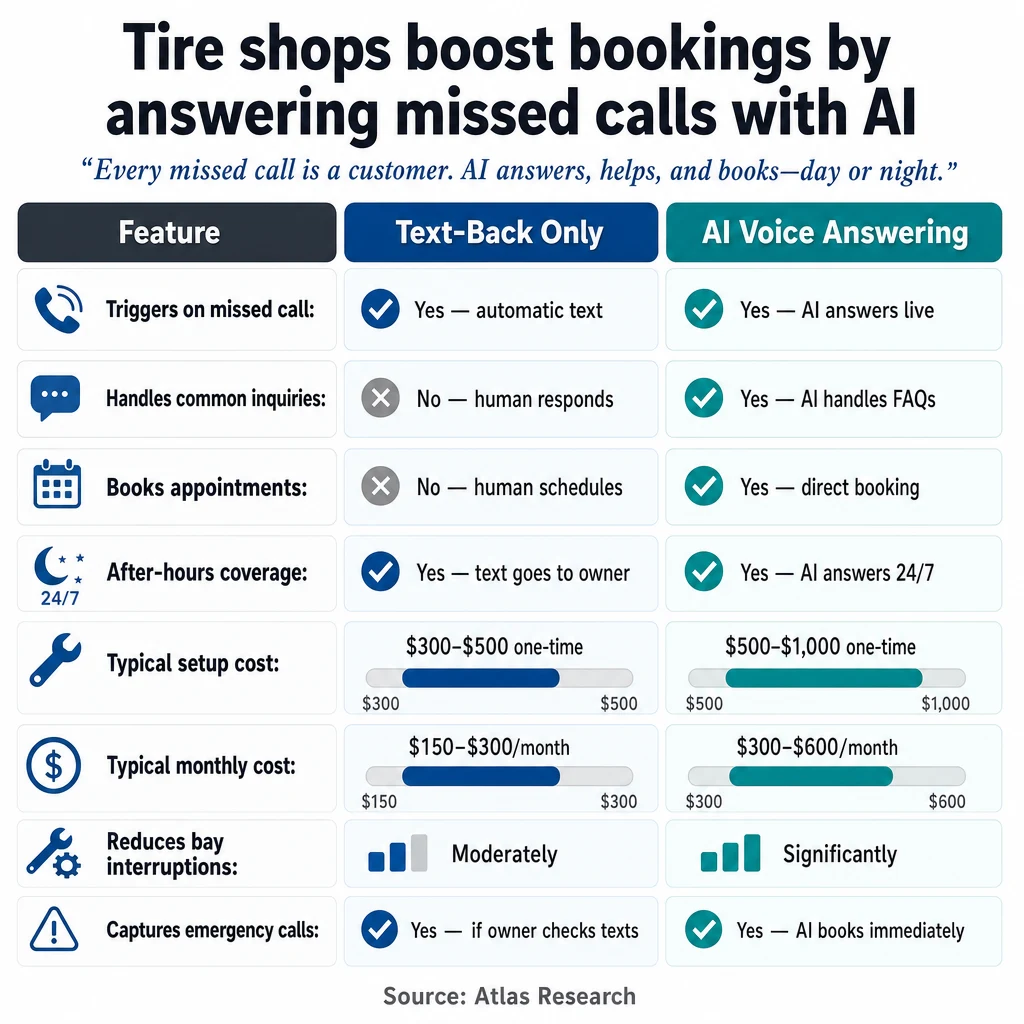
| Feature | Text-Back Only | AI Voice Answering |
|---|---|---|
| Triggers on missed call | Yes automatic text | Yes AI answers live |
| Handles common inquiries | No human responds | Yes AI handles FAQs |
| Books appointments | No human schedules | Yes direct booking |
| After-hours coverage | Yes text goes to owner | Yes AI answers 24/7 |
| Typical setup cost | $300-$500 one-time | $500-$1,000 one-time |
| Typical monthly cost | $150-$300/month | $300-$600/month |
| Reduces bay interruptions | Moderately | Significantly |
| Captures emergency calls | Yes if owner checks texts | Yes AI books immediately |
The right system for your shop depends on call volume, staff availability for text responses, and whether you want the AI to handle the full conversation or simply open a text channel for your team to manage.