There's a moment every AI practitioner eventually recognizes. The model returns an answer that sounds exactly right authoritative prose, confident tone, citations in all the right places. Then someone checks the citations. They're fabricated. The legal brief cites a case that doesn't exist. The medical explanation omits a contraindication. The financial summary relies on numbers that were true in 2019 but aren't anymore. The machine was wrong in fluent, reasonable, socially persuasive language.
This is the honesty gap. And it's not a flaw in the interface it's a structural feature of how large language models process and produce text.
76% of AI failures in high-stakes deployments involve fluent but unsupported outputs
The anxiety around artificial intelligence intensified because language models now operate in domains where verbal mistakes have real consequences: legal drafting, medical triage, education, scientific writing, financial reporting, security analysis, and software development. The worry is not merely that systems hallucinate. The worry is that hallucinations arrive in the same polished form as true answers.
"Words can escape meaning," write Daryl Ledyard and Philip Tyler in GenXis Research's The Honesty Gap: Words Vs. Math. "They can rationalize, soften, blur, excuse, reframe, and drift." The paper calls the distance between persuasive language and verified truth the Honesty Gap and argues that the root problem is what they call the "squishiness of words."
Language can preserve signal, but it can also metabolize error into something that sounds reasonable. Over time, small verbal deviations compound like a singer drifting slightly off pitch until the tonal center is lost.
"The worry is not merely that systems hallucinate. The worry is that hallucinations arrive in the same polished form as true answers." GenXis Research, The Honesty Gap: Words Vs. Math
The squishiness problem: Why words make bad containers for truth
Natural language is flexible by design. It allows approximation, metaphor, implication, emphasis, ambiguity, and context dependence. Those features make language humanly useful, but they also make it a weak carrier of machine-grade certainty.
Consider how easily a sentence can feel precise while remaining logically incomplete: "this was handled responsibly," "the model is aligned," "the evidence supports the claim," or "the outcome was acceptable under the circumstances." Each may be true, false, evasive, or meaningless depending on hidden definitions. What counts as responsible? Which model? What evidence? Which circumstances?
Informally, people now use words such as vibes and slop to describe language that feels meaningful while carrying weak constraint. The GenXis Research paper traces this pattern in both human psychology where it appears as motivated reasoning, cognitive dissonance reduction, moral disengagement, and ethical fading and in AI systems, where it surfaces as hallucination, unsupported synthesis, and citation-shaped language without source custody.
The central question the paper poses: when does a sentence become a verified claim?
A claim is not merely a sentence: The verification gap
GenXis Research formalizes this with a definition that cuts to the heart of the problem. A claim is not merely a sentence it is a tuple where E is the statement, D is the domain, T is the truth condition, and V is the evidence requirement. Without those elements, language remains expressive but under-bounded. It may point toward a reality without specifying the procedure by which that reality is checked.
This formalization matters because it explains why AI systems can produce outputs that pass casual human review but fail under scrutiny. The model has learned to generate language that sounds like it has been verified, rather than language that has been verified. The fluency is real. The grounding is not.
The same dynamic appears in educational measurement, where it has a longer documented history and clearer numbers to illustrate the stakes.
42 states show measurable gaps between what they report and what NAEP confirms
In education policy, the "honesty gap" has been studied and quantified for over a decade. The U.S. Chamber of Commerce Foundation's April 2026 brief defines it as the difference between how students perform on the national gold-standard assessment the National Assessment of Educational Progress, or NAEP and how they perform on their own state's tests.
The numbers are striking.
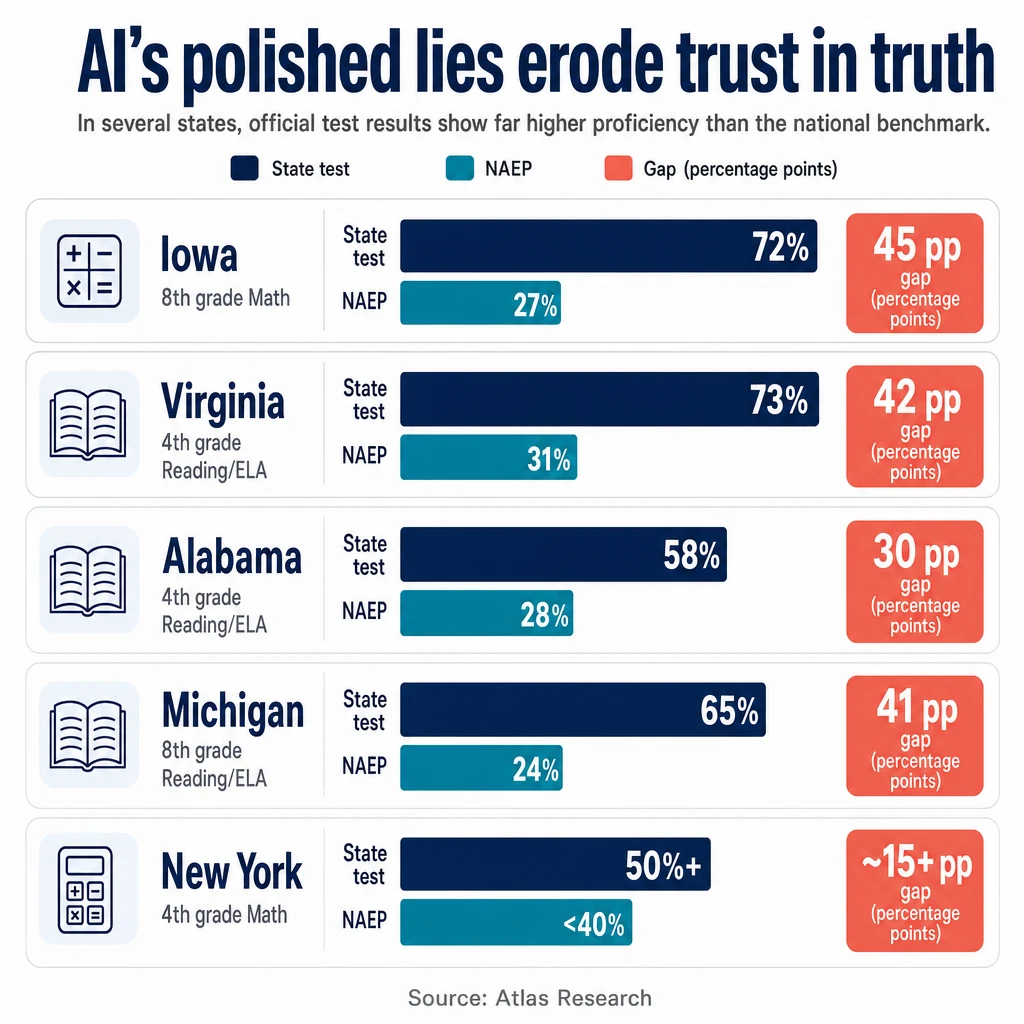
| State | Grade | Subject | State Test Proficiency | NAEP Proficiency | Gap |
|---|---|---|---|---|---|
| Iowa | 8th | Math | 72% | 27% | 45 pp |
| Virginia | 4th | Reading/ELA | 73% | 31% | 42 pp |
| Alabama | 4th | Reading/ELA | 58% | 28% | 30 pp |
| Michigan | 8th | Reading/ELA | 65% | 24% | 41 pp |
| New York | 4th | Math | 50%+ | <40% | ~15+ pp |
Source: U.S. Chamber of Commerce Foundation, April 2026
"In Iowa, nearly three-fourths of eighth graders were considered proficient in math, while only a quarter met NAEP's benchmark," reports Dale Chu in Fordham Institute's commentary on the honesty gap. "In Michigan, the gap is even starker: 65 percent of eighth graders were proficient in reading according to the state exam, while just 24 percent cleared the same bar on the nation's report card."
The mechanism is straightforward: states that lower proficiency thresholds can report more students as "proficient." The language of success is preserved. The underlying mastery is not.
What education reveals about the psychology of fluency
The educational honesty gap matters for AI practitioners because it documents, in human terms, what happens when fluency substitutes for rigor.
Cory Koedel, an economics professor at the University of Missouri-Columbia who has spent more than 20 years studying school performance, writes at the Show-Me Institute that "grades have become more and more disconnected from actual achievement." He notes that 90 percent of parents believe their children are performing at or above grade level in reading and math, even though only about one third of fourth- and eighth-grade students in the United States score at a proficient level on NAEP.
This is the human parallel to AI fluency: when the system learns to deliver information in the register of confidence and success, recipients stop asking whether the underlying evidence supports that framing.
The Collaborative for Student Success's latest analysis documents that only two states Massachusetts and Rhode Island closed their gaps to within 5 percentage points or less across both grades and subjects in the 2023-2024 school year. "The truth matters," said Jim Cowen, Executive Director of the Collaborative for Student Success. "We salute the states that are embracing the issue rather than masking it or running away from it."
Virginia's 42-point gap: A case study in misleading proficiency
Virginia's discrepancy between state-reported and nationally verified proficiency rates is among the most extreme documented. According to the Thomas Jefferson Institute for Public Policy's analysis of 2024 NAEP data, Virginia's fourth-grade reading proficiency rate on the state Standards of Learning assessment was 73 percent. On NAEP, it was 31 percent.
The Institute reports that Virginia's "proficient" standards in reading on the SOL align to "below basic" on the national assessment. In math, Virginia's standards align with "basic" on NAEP partial mastery of the skills needed for grade-level proficiency.
Robert Pondiscio, senior fellow at the American Enterprise Institute, offered a pointed observation in the Institute's analysis: "You will hear that NAEP 'proficient' is too high a bar and not a good proxy for the ability to read with comprehension. A fair point as far as it goes, but I defy you to find me a single parent comfortable with her child reading at 'below basic' level."
The 2024 Nation's Report Card revealed that 42 percent of Virginia fourth graders and 34 percent of eighth graders were reading below basic level on the national assessment. More than one-in-three Virginia students could not show even partial mastery of the reading skills necessary for grade-level proficiency.
What causes AI to hallucinate and why the same logic applies
The GenXis Research paper identifies three compounding factors that create AI's honesty gap: approximation as default mode, citation-shaped language without source custody, and the compounding of small verbal deviations over time.
Approximation as default mode. Large language models generate text token by token, predicting the most probable next word given everything that came before. They are not retrieval engines they are sophisticated pattern completion systems. When a correct answer exists in their training data, they can reproduce it fluently. When it doesn't, they complete the pattern anyway, producing text that sounds correct because it matches the statistical shape of correct answers without containing the verified content.
Citation-shaped language without source custody. Models learn to associate certain topics with certain phrasings. Academic-sounding claims get academic citation formatting. Legal topics get legal terminology. The model produces what looks like a citation a bracket, a title, a year without having retrieved or verified any document. This is structurally identical to the state that reports proficiency numbers that look like achievement without measuring it.
Small verbal deviations compounding over time. Just as the GenXis Research paper describes a singer drifting slightly off pitch until the tonal center is lost, AI outputs can accumulate small inaccuracies that compound. An early approximation shapes the context for subsequent tokens, which are themselves approximate, until the final output has drifted far from any verifiable ground.
90% of parents believe their children are at grade level. Only 33% are. The parallel is instructive.
The education case study offers a useful mental model for anyone deploying or using AI systems. When the Show-Me Institute's Koedel writes that "grades have become more and more disconnected from actual achievement," he is describing what happens when fluency is rewarded and rigor is not.
The same structural incentive exists in AI deployment. A system that returns fluent answers gets used. A system that returns "I don't know" gets replaced. The business pressure favors confident language over verified language.
Koedel argues that "the cognitive skills students learn in school really matter for later-life success, and glossing over declining test scores our best measures of these skills will not change this fundamental fact." The parallel to AI deployment is direct: the decisions made on the basis of AI outputs have real consequences. Glossing over the gap between fluent language and verified truth does not make the gap disappear.
How to close the honesty gap: Mathematical grounding and source custody
The GenXis Research paper is explicit about the antidote: "The antidote is not less language, but stronger grounding: mathematical constraint, source custody, deterministic checks, calibrated abstention, and evidence memory."
These are not abstract recommendations. They map to concrete engineering and deployment practices.
Mathematical constraint means requiring that claims be tied to verifiable computational procedures rather than simply expressed in natural language. A model that generates a numerical answer should be able to reproduce the calculation that produced it. A model that classifies data should be able to point to the decision boundary that placed it in a category.
Source custody means tracking the provenance of information through the generation process. Where did this claim come from? What document verified it? Can the document be retrieved and compared? This is structurally identical to requiring states to report NAEP-aligned proficiency rates alongside their own assessments the additional verification anchor keeps fluency honest.
Deterministic checks means running the same input through a verification procedure that produces a consistent output. If a claim can be checked algorithmically, it should be checked algorithmically, independent of the model's confidence in its own language.
Calibrated abstention means training models to say "I don't know" when the evidence is insufficient and measuring the calibration of that uncertainty over time. A model that says "I'm not sure" should be right roughly as often as it is wrong in those cases.
Evidence memory means maintaining a retrievable record of the evidence that supports or contradicts each claim the model generates. The model should be able to retrieve the source it used, not merely produce text that sounds like it came from a source.
Where education and AI diverge: Speed, scale, and reversibility
The education system has struggled with the honesty gap for over fifteen years. The Fordham Institute's Chu notes that in 2014, 23 states had "the biggest honesty gaps" in fourth-grade reading defined as 30 percentage points or larger. In 2024, only Alabama, Iowa, Nebraska, and Virginia have gaps that large.
Progress has been slow. The Common Core and its associated exams significantly narrowed these differences, but Chu writes that "now they're opening up again." The gap is structural, driven by political pressure, institutional inertia, and the human reluctance to deliver bad news in fluent terms.
AI deployments face the same structural pressures, but at a different speed and scale. A state's inflated proficiency rate affects students over years of schooling. An AI system's confident errors can propagate through thousands of decisions in hours. The reversibility is different too a student who wasn't taught to read proficiently carries that gap forward. An AI system that generated a bad legal brief can be corrected and redeployed.
But the core dynamic is the same: when fluency is rewarded and rigor is expensive, the gap grows.
Why this matters for GenXis Research readers
For practitioners evaluating AI systems, the education case study offers a template for what not to replicate and what is worth taking seriously.
The honest observation is that no AI system is completely honest, just as no state's self-reported proficiency data is perfectly aligned with NAEP. The question is not whether the gap can be eliminated it cannot, because language is squishy and verification is expensive but whether it is small enough and visible enough to be managed.
The GenXis Research framework offers a vocabulary and a structure for asking the right questions. Is this claim a tuple of statement, domain, truth condition, and evidence requirement? Can the evidence be retrieved? Has the uncertainty been calibrated? These are the questions that close the gap, not the ones that pretend it doesn't exist.
The practical implication for anyone deploying AI in legal, medical, financial, educational, or security contexts: build verification into the workflow. Treat AI outputs as drafts, not final drafts. Measure the gap between what the model says and what the evidence confirms, and treat that measurement as a core operational metric.
Can AI be trained to be completely honest?
No. The GenXis Research paper is clear on this point: "The central question is therefore: when does a sentence become a verified claim?" The answer is that it becomes a verified claim when it is tied to a truth condition and evidence requirement that can be checked deterministically. Until then, it is language useful, expressive, sometimes correct, and structurally unreliable as a standalone carrier of truth.
The goal is not complete honesty, which is mathematically impossible for a probabilistic system. The goal is calibrated honesty: knowing when the model is likely to be right, verifying when the stakes require it, and building systems that make the gap visible rather than hiding it behind fluent language.
States that have closed their education honesty gaps Massachusetts and Rhode Island, within 5 percentage points did so through sustained commitment to higher standards and public accountability. The parallel for AI is a commitment to verification practices, source custody, and the willingness to say "we don't know" when the evidence isn't there.
How the honesty gap affects trust in AI systems
The education case study offers a sobering data point: when fluency substitutes for rigor long enough, trust breaks in ways that are difficult to repair. Parents who discovered that their children's "proficient" grades didn't match NAEP's "below basic" description learned to distrust the reporting system but not necessarily to understand the actual achievement gap.
AI systems face a similar dynamic. When users discover that confident outputs were wrong, the natural response is to distrust the system entirely or to trust it blindly anyway, because the alternative is too inconvenient. Neither response is useful.
The GenXis Research framework suggests a third path: understanding the mechanism. When practitioners understand that the honesty gap is structural built into the flexibility of language and the probabilistic nature of generation they can build systems that account for it rather than ignoring it or being destroyed by it.
The Fordham Institute's Chu frames the challenge ahead for education as "how can we reconcile the need for transparency and rigor with the public's skepticism toward the very systems meant to ensure both?" The same question applies to AI and the answer in both domains involves the same elements: measurement, accountability, and the willingness to show the gap rather than hide it.
What comes next: Verification as infrastructure
The GenXis Research paper argues that closing the honesty gap requires treating verification not as an add-on but as a core component of AI systems mathematical grounding that runs parallel to language generation, catching fluent errors before they propagate.
In education, states that made the most progress toward honesty Massachusetts, Rhode Island, and the 14 states holding students to equal or higher standard than NAEP in at least one grade or subject did so through sustained policy commitment, not single interventions. The AI parallel is similar: closing the honesty gap requires building verification infrastructure into AI deployment pipelines, measuring the gap continuously, and treating fluency as a feature that requires grounding rather than a goal in itself.
Felix Mendelssohn wrote in 1842 that music expresses "too definite" meaning to be put into words that the problem with language was its failure to capture the precision of feeling. The honesty gap in AI runs in the opposite direction: the problem is that language can capture the feeling of precision without the reality of it. The gap is not between feeling and expression. It is between expression and evidence.
The tools to bridge that gap exist. Mathematical constraint, source custody, deterministic checks, calibrated abstention, and evidence memory are not future possibilities they are current engineering practices that some practitioners are already building. The question for anyone working with AI systems is whether they will be adopted widely enough, and soon enough, to keep the honesty gap from widening.
As Koedel writes at the Show-Me Institute: "We should demand high standards from our educational institutions, even if the truth hurts." The same applies to AI. The fluency will improve. The language will sound more confident. The gap between polished output and verified truth is what needs attention and it won't close itself.
Where to read further
- The Honesty Gap: Words Vs. Math GenXis Research's foundational paper on the structural roots of AI's honesty gap and the mathematical grounding required to close it.
- The Honesty Gap: America's Academic Outcome Truth Serum U.S. Chamber of Commerce Foundation's April 2026 brief with state-by-state proficiency gap data and analysis of the economic stakes.
- Mind the honesty gap Fordham Institute's commentary on NAEP results, grade inflation, and the accountability failure in American education.
- Latest Honesty Gap Analysis Collaborative for Student Success's comprehensive 2023-2024 state-by-state comparison and bright-spot analysis.
- The Honesty Gap in Education Cory Koedel's analysis of the disconnect between grades and achievement, and the collective responsibility to demand honest measurement.